3.3 The Permit Application Process (Non-Emergency Work)

There is one permit application form that covers Street Opening, Building Operations/Construction Activity, and Sidewalk Construction permits for non-governmental work. These applications should be submitted online using NYCStreets. Applicants who would like the paper form can download the Application for Roadway/Sidewalk Permit(s) or see Appendix B, Forms
3.3.1 Common Requirements for All Permit Types
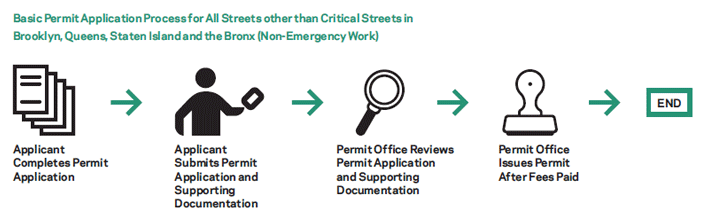
- Applicants must be registered with NYC DOT and have a Permittee ID Number, except in the case of a Sidewalk Repair Permit taken out by a homeowner, where the work will be performed by the homeowner.
- Utilizing the NYCStreets Permit Management system applicants must submit a completed permit application online. The online application contains business and contact information; proposed work information, including location, size of proposed work, and the work start and end date; type of permit(s) being requested; detailed work zone sketch.
- Applicants must obtain all applicable permits and/or approvals from any other governmental agencies prior to applying for a permit. Common examples include approval from the New York City Department of Parks and Recreation (Parks) if any street trees or tree pits will be affected by the proposed work; a permit from the New York City Department of Environmental Protection (DEP) if any water or sewer line will be affected; and a Certificate of Appropriateness from the New York City Landmarks Preservation Commission (LPC) if the proposed work is within an Historic District. A table showing the agencies that must be contacted prior to applying for certain NYC DOT permit types can be found in Appendix A, Common Permit Types and Documents Needed; a list of contact numbers for these agencies can be found in Appendix D, Other Agency and Utility Contact Information.
- If the applicant intends to work on a contract that has been awarded by a government agency or authority, the applicant must submit a copy of the contract, Order on Letter, Notice to Proceed or a Letter of Authorization to the Government Contract office via email to governmentcontracts@dot.nyc.gov.
- If the applicant intends to fully close a roadway, a Request for Full Roadway Closure must be completed or see Appendix B, Forms. To obtain more information on full roadway closures, contact OCMC via email to FullRoadwayClosure@dot.nyc.gov
- If the applicant intends to do work associated with a Franchise, Concession or Revocable Consent Agreement, the applicant must have a copy of the Agreement prior to applying for a permit.
- Any work is subject to suspension during an NYC DOT-issued embargo period*, unless otherwise designated.
Questions regarding application processes can be directed to the Permit Office via email to constructionpermits@dot.nyc.gov.
3.3.2 Application Procedures for a Street Opening Permit
Street Opening Permits are required for excavations or other work in a city street that disturbs the street surface.
Outlined below are the basic application procedures for Street Opening Permits. These are in addition to the "Common Requirements" listed at the beginning of this section. Additional requirements are contained in Sections 2-02 and 2-11 of the Highway Rules and should be consulted before any work is performed on the street.
- Street Opening Permits are designated as the "01" permit series, meaning all permits in this category begin with "01." Listed on the following page are the most commonly requested Street Opening Permit types which may be used when completing an application. A separate permit is required for each street opening activity.
- All Street Opening permit types usually allow for work within 300 linear feet by a width of 12 feet. Other conditions may apply, such as a variation in the distance and width of the job, which may increase the fee required. For further information regarding fees, the applicant should refer to Section 2-03 of the Highway Rules.
- An application for a Street Opening Permit on a protected street will automatically be placed on a Street Arterial Maintenance (SAM) hold if the proposed work is to start within 18 months of the street being resurfaced or reconstructed. The hold is to review the proposed work and set conditions for the work and/or the street restoration. More information on this and other "holds" that may be placed on permit applications can be found in Section 3.5 Other Provisions Pertaining to Permits of this chapter.
Information on restoration requirements following street openings/excavations can be found in Chapter 4 Executing Work in the Street.
Protected Streets Listing
A street is considered to be protected for five years from the date it was last resurfaced or reconstructed. The purpose of placing a street in protected status is to maintain the integrity of a new street surface.
The list of protected streets is updated daily and is accurate as of the previous business day. Prior to submitting a Street Opening Permit application, the Protected Streets Listing should be consulted in order to determine if the proposed work location is in protected status. If the proposed work location is in protected street status, the application will automatically be placed on SAM hold for further review.
Only in circumstances where the applicant can demonstrate that the work could not have been reasonably anticipated prior to the street resurfacing/reconstruction will an application for a Street Opening Permit on a Protected Street be reviewed.
The Protected Streets Listing consists of four separate files, each covering all five boroughs:
- Protected street status for segments
- Protected street status for intersections
- Active/Future start dates of projects for segments
- Active/Future start dates of projects for intersections
All streets on the "Active/Future" lists show the anticipated start date of the project. This information should be used to plan work before streets go into protected street status.
View the Protected Streets Listing.
| Street Opening Permits (Non-Protected) | Street Opening Permits (Protected) |
||||
| TYPE | NAME | FEE | DURATION IN DAYS | PERMIT NO. | FEE |
|---|---|---|---|---|---|
| 0100 | Open Sidewalk To Install Foundation | $135 | 30/90 | 0100P | $135 |
| 0102 | Major Installations – High Voltage | $135 | 30/90 | 0102P | $380 |
| 0103 | Major Installation – Gas | $135 | 30/90 | 0103P | $380 |
| 0105 | Major Installations – Telephone | $135 | 30/90 | 0105P | $380 |
| 0106 | Transformer Vault – In Roadway | $135 | 30 | 0106P | $380 |
| 0107 | Transformer Vault – In Sidewalk Area | $135 | 30 | 0107P | $135 |
| 0108 | Cores or Borings | $135 | 30 | 0108P | $135 |
| 0109 | Major Installations – Water | $135 | 30/90 | 0109P | $380 |
| 0110 | Major Installations – Cable | $135 | 30/90 | 0110P | $380 |
| 0111 | Major Installations – Sewer | $135 | 30/90 | 0111P | $380 |
| 0112 | Rapid Transit Construct/Alteration | $135 | 30/90 | 0112P | $380 |
| 0113 | Repair Water | $135 | 30 | 0113P | $380 |
| 0114 | Repair Sewer | $135 | 30 | 0114P | $380 |
| 0115 | Repair Water - Sewer | $135 | 30 | 0115P | $380 |
| 0116 | Fuel Oil Line | $135 | 30 | 0116P | $135 |
| 0117 | Vault Construction or Alteration | $135 | 30 | 0117P | $135 |
| 0118 | Reset, Repair Or Replace Curb | $135 | 30 | 0118P | $135 |
| 0119 | Pave Street-W/ Engineering & Inspection Fee | $135 | 30 | 0119P | $135 |
| 0120 | Tree Pits | $135 | 30 | 0120P | $135 |
| 0121 | Construct Or Alter Manhole Or Casting | $135 | 30 | 0121P | $380 |
| 0122 | Repair Gas | $135 | 30 | 0122P | $380 |
| 0123 | Repair Steam | $135 | 30 | 0123P | $380 |
| 0124 | Repair Electric/Communications | $135 | 30 | 0124P | $380 |
| 0126 | Test Pits | $135 | 30 | 0126P | $380 |
| 0127 | Conduit Construction And Franchise | $135 | 30 | 0127P | $380 |
| 0128 | Erect Canopy | $135 | 30 | ||
| 0129 | Install Street Furniture | $135 | 30/90 | 0129P | $135 |
| 0130 | Land Fill | $135 | 30 | 0130P | $135 |
| 0131 | Private Sewer | $135 | 30 | 0131P | $380 |
| 0132 | Install Fence | $135 | 30 | 0132P | $135 |
| 0133 | Install Traffic Signals | $135 | 30 | 0133P | $380 |
| 0134 | Repair Petroleum Leak | $135 | 30 | 0134P | $380 |
| 0138 | Installation Of Fire Alarm Box | $135 | 30 | 0138P | $135 |
| 0139 | Installation Of Bus Shelter | $135 | 30 | 0139P | $135 |
| 0151 | Installation Public Pay Telephone | $135 | 30 | 0151P | $135 |
3.3.3 Application Procedures for a Building Operations/Construction Activity Permit
Building Operations/Construction Activity Permits apply to construction activities that take place within the street and are generally associated with construction work adjacent to the street. A valid permit issued by DOB is usually required in order to apply for permits in this category. Some of the activities covered include placement of materials, equipment and temporary structures on the street or movement of construction equipment across roadways and sidewalks. It also covers installations above the street such as banners and decorative lights and permanent installations on the street such as bike racks.
Outlined below are the basic application procedures for Building Operations/Construction Activity Permits. These are in addition to the "Common Requirements" listed at the beginning of this section. Additional requirements are contained in Sections 2-02 and 2-05 of the Highway Rules and should be consulted before any work is performed on the street.
- Building Operations/Construction Activity Permits are designated as the "02" permit series, meaning all permits in this category begin with "02". Listed in the table are the most commonly requested Building Operations/Construction Activity Permit types, which may be used when completing an application. A separate permit is required for each construction-related activity, except where otherwise provided in the Highway Rules or by permit stipulations.
- An Occupancy of Sidewalk Permit is required when either more than 3 feet from the property line is obstructed by a fence or a minimum of 5 feet of clear path cannot be maintained for pedestrians, or as otherwise stipulated.
- An Occupancy of Roadway Permit is required for closing all or part of one or more lanes of roadway and/or during blasting operations.
- A permit is required to place any construction trailer or similar structure in the street.
- For building operations, a crane permit is required for all cranes and derricks operating in the street on building construction or related activity under the jurisdiction of DOB, with the exception of truck cranes with telescopic, hydraulic or folding booms, over 50 feet and not more than 135 feet with a maximum rated capacity of 3 tons, for which a construction activity permit has been issued. Other requirements may apply to the movement of cranes within city limits, such as daily or annual over-dimensional travel permit(s) as issued by NYC DOT.
- For street operations, a crane permit is required for all cranes and derricks operating in the street with a maximum rated capacity greater than 20 tons and which are not related to building operations. Other requirements may apply to the movement of cranes within city limits, such as daily or annual over-dimensional travel permit(s) as issued by NYC DOT.
- The applicant may be required to address the circumstances of a hold before a permit is released. An explanation and description of "Holds" may be found in Section 3.5 Other Provisions Pertaining to Permits of this chapter.
Building Operations/Construction Activity Permits
| PERMIT NO | NAME | FEE | DURATION |
|---|---|---|---|
| 0201 | Place Material on Street | $50 | 90 days |
| 0202 | Crossing Sidewalk | $50 | 90 days |
| 0203 | Place Crane Or Shovel On Street | $50 +$100 inspection fee | 1 week |
| 0204 | Place Equipment Other Than Crane Or Shovel | $50 | 90 days |
| 0205 | Place Shanty Or Trailer On Street | $50 | 90 days |
| 0207 | Franchise Installations (Overhead Structures) | $50 | 90 days |
| 0208 | Temporary Pedestrian Walk | $50 | 90 days |
| 0211 | Occupancy Of Roadway As Stipulated | $50 | 90 days |
| 0214 | Place Container On The Street | $50 | 90 days |
| 0215 | Occupancy of Sidewalk As Stipulated | $50 | 90 days |
3.3.4 Application Procedures for a Sidewalk Construction Permit
Sidewalk Construction Permits apply to any repairs, replacements or new sidewalk installations.
Outlined below are the basic application procedures for Sidewalk Construction Permits. These are in addition to the "Common Requirements" listed at the beginning of this section. Additional requirements are contained in Sections 2-02 and 2-09 of the Highway Rules and should be consulted before any work is performed on the street.
- Sidewalk Construction Permits are designated as the "04" permit series, meaning all permits in this category begin with "04". Listed in the table are the most commonly requested Sidewalk Construction Permit types, which may be used when completing an application. A permit is not required to install, repave, reconstruct or repair any sidewalk where the work involves an area of less than 25 square feet, unless the purpose of the work is to remove a violation.
- A separate Occupancy of Sidewalk Permit is required if a minimum of 5 feet cannot be maintained on the sidewalk for unobstructed pedestrian passage.
- If the existing sidewalk is the structural roof of a vault or other opening, a DOB-approved plan for the restoration of the sidewalk, must be submitted as part of the application process.
- The applicant may be required to address the circumstances of a hold before a permit is released. An explanation and description of "Holds" may be found in Section 3.5 Other Provisions Pertaining to Permits of this chapter.
NYC DOT accepts and processes applications by mail for sidewalk repair performed by private homeowners. This unique procedure is described below.
Applying for a Sidewalk Repair Permit by Mail (Private Homeowners ONLY)
If a private homeowner is applying for a Sidewalk Repair Permit, and will be making the repair by himself/herself, the homeowner may apply for a permit by mail. (If the homeowner is using a contractor, the contractor must be registered with NYC DOT and must take out the permit.) Outlined below are the basic procedures in applying for a Sidewalk Repair Permit by mail:
- The private homeowner must complete the application for a Roadway/Sidewalk Permit. This permit application can also be found in Appendix B, Forms, or by calling 311.
- A mandatory Affidavit of Ownership must be completed, notarized and the original returned with the permit application. This form may also be obtained in Appendix B, Forms. This form verifies that the person applying for the permit is the homeowner and will be performing the repairs to the sidewalk pursuant to the permit issued by NYC DOT. No permit will be issued unless the affidavit is complete and notarized.
- The completed application, affidavit, a stamped self-addressed envelope and a certified check made payable to NYC DOT for the permit fee (currently $70.00 for up to 300 linear feet) must be mailed to:
The New York City
Department of Transportation
Permit Management & Construction Control Permit by Mail
55 Water Street, Concourse Level
New York, New York 10041
Upon receipt of the above and verification for completeness, a Sidewalk Repair Permit will be issued and mailed to the applicant. Information on the restoration requirements for sidewalk repairs can be found in Chapter 4 Executing Work in the Street.
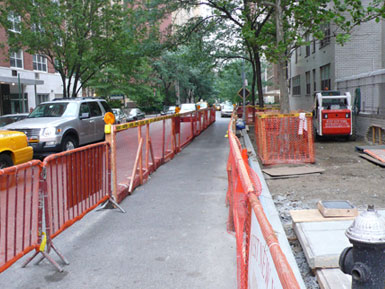
A permit is required for new sidewalk installation, repairs, and replacements. Projects requiring sidewalk closure may require additional permits.
Sidewalk Construction Permits
| PERMIT NO | NAME | FEE | DURATION |
|---|---|---|---|
| 0401 | Repair Sidewalk | $70 | 30 days |
| 0402 | Construct New Sidewalk | $70 | 30 days |
| 0403 | Replace Sidewalk | $70 | 30 days |
| 0404 | Construct New Sidewalk With Heating Pipe | $70 | 30 days |
| 0405 | Construct New Sidewalk Builders Pavement | $70 | 30 days |
3.3.5 Permit Application Review and Issuance (for Street Opening, Building Operations/ Construction Activity, and Sidewalk Construction Permits)
Permit Review is the process by which NYC DOT reviews permit applications and supporting documentation and makes determinations regarding the issuance of permits and permit stipulations. Applications are submitted online utilizing the NYCStreets Permit Management system.
Application Review Procedures
With the exception of homeowner/property owner and canopy permits, all applications must be submitted online using NYCStreets.
Following are the steps for permit application, review and issuance:
- The applicant submits the online permit application, and supporting documentation for review.
- If the application and its supporting documentation are complete, the OCMC Project Manager (PM) reviews the application and all associated documents and adds the permit stipulations to the permit application.
- During the processing of the permit, if there is a hold, the applicant is notified via email of the type of hold and the steps the applicant must take to release the hold. Section 3.5 Other Provisions Pertaining to Permits contains more information on holds.
- If there is no hold, the permit is issued to the applicant after appropriate payment is received.
Application Procedures in Borough Permit Offices
The borough permit offices are open for inquiries and to process homeowner/property owner applications for sidewalk repair work as that application is not available online. The permit offices in Brooklyn, Queens and Staten Island have reduced hours. See below:
Brooklyn - 16 Court St., 15th Floor Wednesdays only, 8:30am-3:30pm Appointment needed: (646) 892-1388
Queens - 120-55 Queens Blvd., Room 1-240 Tuesdays and Wednesdays only, 8:30am-3:30pm Appointment needed: (212) 839-2473
Staten Island - 10 Richmond Terrace, Room 308 Wednesdays only, 8:30am-3:30pm Appointment needed: (212) 839-2387
Bronx – Permanently closed in 2019.
Manhattan (Central Office) - 55 Water St., Concourse Level (enter from South St. & Vietnam Veterans Memorial Plaza) Monday thru Friday, 8:30am-3:30pm
Appointments recommended: (212) 839-9570; walk-ins welcome. Permits for all five boroughs can be issued at this location.
3.3.6 Permit Renewals and Re-Issuances (for Street Opening, Building Operations/Construction Activity, and Sidewalk Construction Permits)
All construction-related permits have expiration dates. If a permit is about to expire and the permittee has not completed the work, the permittee must apply for a permit renewal as all work must be performed pursuant to an active permit at all times. The permittee may apply for a renewal online. The permittee must attach a copy of the original permit(s) to the online application when it is submitted for renewal and all applicable reviews and fees will apply. Renewal requests can be submitted for permits that have not expired.
Permits that have expired may be reissued only within 30 days  of expiration. The permittee may apply for a re-issuance online. Re-issued permits will not apply retroactively and are subject to new permit stipulations. The permittee must attach a copy of the original permit to the application when requesting a re-issuance and all applicable reviews and fees will apply. If the permit has been expired for more than 30 days , a new permit application must be submitted.